#006: The Navier–Stokes problem
On September 8, 2026, OpenAI announced that an internal AI system had produced a result for the “Navier-Stokes existence and smoothness problem,” one of the seven Millennium Prize Problems! I’ve read OpenAI’s announcement, a small part of the accompanying proof summary, and a couple of reports about the result.
Before continuing, I want to be transparent about the extent of this blog post. I am not a mathematician, and this is based on a limited review of the available public sources rather than an exhaustive analysis. Please read it as my personal perspective on the engineering implications, and not as a definitive assessment of the proof or a substitute for expert mathematical review.
My first reaction was simple: this is either one of THE most important demonstrations related to AI-assisted mathematics so far… or one of the most important demonstrations of WHY extraordinary claims need to be backed up by extraordinary verification.
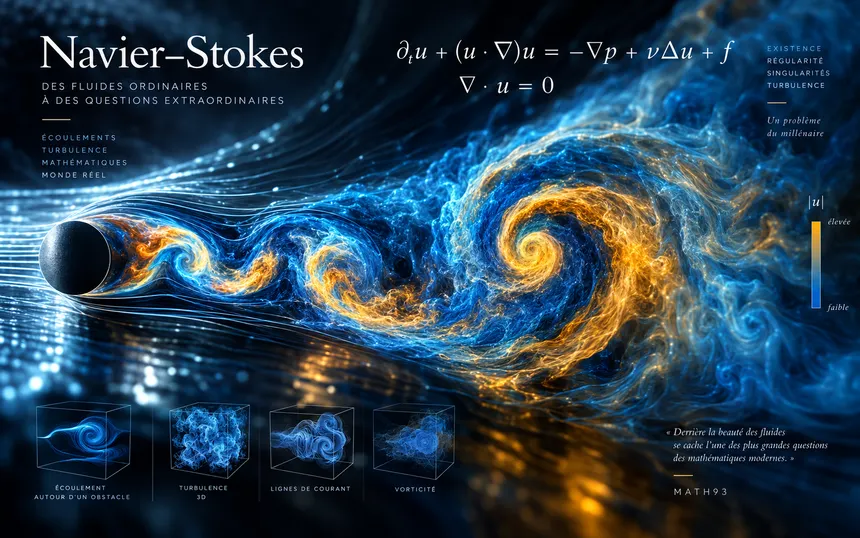
Simply put, the headline still needs some precision. Navier-Stokes is not just an equation that needs to be solved once. The problem asks whether a smooth, three-dimensional, incompressible fluid must remain smooth forever, or whether its velocity can develop a singularity in finite time. OpenAI says its system constructed a finite-time blowup and formalized the argument in Lean, a proof assistant that can mechanically check the logical steps.
While that is still an impressive claim, and potentially a solution to the Navier-Stokes problem, it is not yet the same as a fully vetted proof accepted by the mathematical community. You may remember the famous example from Principia Mathematica, the foundational work by Bertrand Russell and Alfred North Whitehead published between 1910 and 1913, in which formalizing even basic mathematics behind 1+1=2, required around 360 pages.
That being said, while still being verified, this attempt is very different from asking a machine-learning model to predict tomorrow’s weather or simulate airflow around an aircraft. If the argument withstands scrutiny, it is a valid way to address the problem.
OpenAi explained how the system reportedly coordinated many agents, searched for useful mathematical constructions, ran code, combined promising ideas, and then translated the result into a machine-checkable form. The impressive part is not only the final proof. It is the research loop:
generate ideas -> test ideas -> reject failures -> formalize survivors -> verify
As is the case with most famous things online, it is not without controversy. You can find a running summary of the announcement and the surrounding discussion here.
Why this matters to me
1. The breakthrough is a system design showcase, not a chatbot.
The result points toward AI systems that can plan, delegate, experiment, and critique their own work. A single model producing a clever paragraph is useful, but a group of agents coordinating experiments and handing a proof to Lean is a much more serious engineering direction.
2. The result is also a warning about scientific process.
OpenAI’s claim is not the same thing as the mathematical community completing its review. The Clay Mathematics Institute described the problem as apparently settled, while emphasizing that the evaluation process is deliberately thorough. Coverage of the announcement also raised questions about priority, attribution, the relationship to work by Tristan Buckmaster and Levent Alpoge, and the use of AI in unpublished research.
While a proof assistant can check that a formal proof follows from its formal definitions; it does not decide whether the problem was framed fairly or whether the assumptions behind the conclusions are complete.
3. Verification is part of intelligence.
The Lean formalization is important because mathematical fluency alone is not enough. Even if a model can sound certain, it is easy for subtle mistakes to slip through. In high-stakes work, the ability to produce an artifact that another tool can check may matter more than the elegance of the generated explanation.
4. Compute changes the economics of discovery.
OpenAI reports roughly 10,000 concurrent agents, 2.7 million messages, and approximately 130 billion output tokens for the Navier-Stokes effort. That makes the achievement exciting, but it also raises an uncomfortable question: are we measuring intelligence, or access to an enormous automated research team?
For future engineers, efficiency, reproducibility, and clear resource accounting will be just as important as benchmark scores. Otherwise, we risk creating a situation like the Library of Babel, where one line of sensible, legible text is surrounded by an incomparably larger volume of gibberish conclusions.
My take
I don’t think that the right conclusion here is that mathematicians are obsolete as some might proclaim.
Instead, in my opinion, the better conclusion is that the job is changing. A valuable researcher or engineer will know how to turn a vague question into easier subproblems, build tools to expose errors, and explain results well enough for other people to challenge them.
Coincidentally, That is the skill I want to keep developing. The future of AI research will not belong only to people who can prompt a model but also to people who can design reliable loops around models: planning, coding, evaluation, formal verification, documentation, and human judgment.
OpenAI may have cleared a remarkable mathematical route, but the real lesson, for me, is about how to train for the next one. I want to be the person who can build the tools, question the claims, and make the whole process useful to someone besides the model that produced it.
Further reading
- OpenAI: On the Navier-Stokes Millennium Prize Problem
- OpenAI: Finite time blowup for Navier-Stokes
- Clay Mathematics Institute: Navier-Stokes Announcement